
 English
 French
 German
 Russian
 Italian
 Thai
Thai Turkish
 Japanese
 Spanish
New technology for real-time monitoring of laser welding quality
Time:2025-12-18
Views:110
New technology for real-time monitoring of laser welding quality
I. Application Status and Traditional Limitations of Laser Welding
As a core process for joining metals and thermoplastics, laser welding has achieved mature application in highly automated production scenarios such as the automotive industry, thanks to its advantages of no wear, high speed, and high precision. However, for a long time, weld quality inspection has been plagued by technical bottlenecks: traditional methods rely on X-ray, magnetic analysis, or sampling inspection, which can only conduct post-event traceability and cannot real-time judge the quality status during the welding process. This has become a key issue restricting production efficiency and product reliability.
II. Core Technical Principles of Laser Welding
Laser welding is mainly divided into two modes, and its quality difference is directly related to the "keyhole" state:
Conduction welding: Only the surface of the material is melted without deep penetration;
Deep penetration welding: The laser beam quickly penetrates into the material, forming a "keyhole" structure filled with metal and gas vapor.
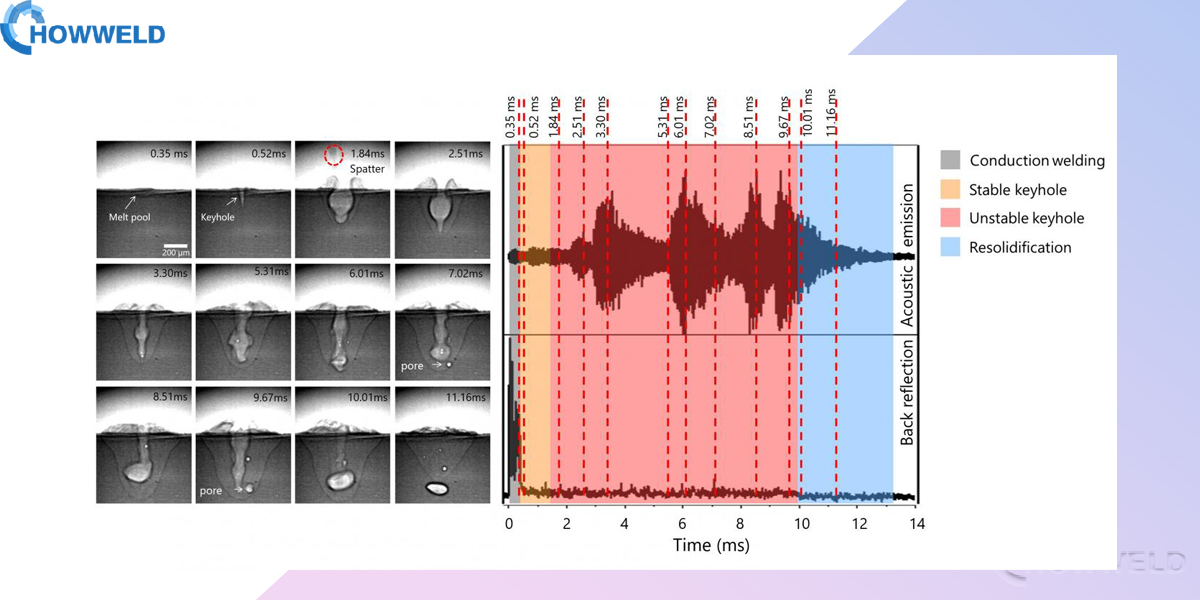
When the keyhole is too deep, the metal vapor pressure decreases with the increase of the surface tension of the molten metal, leading to gradual instability and eventual collapse of the keyhole, forming porosity defects in the weld. The uncontrollability of this process is the core crux affecting welding quality. Traditional technologies can only observe the keyhole from the top through optical methods, failing to accurately capture the moment of its instability.
III. Technological Breakthrough by EMPA Research Team: Real-time Monitoring Solution
To address this pain point, the research team from the European Metal Processing Manufacturers Association (EMPA) has developed an innovative monitoring system, realizing accurate detection and recording of the unstable moments in laser deep penetration welding:
Dual-dimensional data collection: Simultaneously use acoustic sensors to capture acoustic signals during the welding process, and monitor the reflection data of the laser on the metal surface to construct a multi-dimensional information matrix;
AI rapid analysis engine: With the help of convolutional neural networks (artificial intelligence technology), real-time calculation is performed on the collected combined data, with an analysis time of only 70 milliseconds. This achieves real-time dynamic monitoring of the laser welding quality for the first time, breaking the limitation of traditional post-event inspection.
IV. Experimental Verification: Precision Demonstration at ESRF Synchrotron
The research team completed the key verification of technical accuracy at the European Synchrotron Radiation Facility (ESRF), and the experimental process is highly groundbreaking:
Experimental object: Small-sized aluminum plate;
Core operation: Melt a keyhole on the aluminum plate with a laser, scan the aluminum plate with hard X-rays at the same time, and record the entire process (taking less than one hundredth of a second) with a high-speed X-ray camera;
Process observation: Clearly capture the entire welding stage—from the heat conduction stage of surface melting, to the formation of a stable keyhole, to the liquid metal ejection phenomenon of the keyhole similar to a volcanic eruption, and the complete process of pore formation caused by uncontrolled collapse;
Defect control results: Successfully achieved controllable operation of "keyhole manufacturing" and "defect closure", with the success rate of keyhole manufacturing reaching 87% and the success rate of closing the keyhole through a second laser pulse being 73%.
V. Technical Application Prospects and Core Value
The core breakthrough of this research lies in the integrated realization of real-time defect detection and immediate correction:
In traditional processes, weld pores can only be detected after the work is completed. Once defects are found, reprocessing is required, resulting in high costs and low efficiency;
The new scheme can detect pores during the welding process by real-time monitoring the unstable state of the keyhole, and post-processing with laser can start immediately.
This error correction technology has extremely broad application prospects in laser welding. It not only greatly improves the welding qualification rate but also optimizes the production process, providing a new solution for precision welding in the high-end manufacturing field.
Above content writed by Howweld Team that we provide samples testing for free, free sample provided send to customers, welding laser processing for products, equipment with service, provide suitable laser welding, laser cutting solution for sheets plates tubes. Contact email: info@howweld.com
Welcome to inquire, visit and testing samples. We are looking forward to your presence.
 Skype
Skype Whatsapp